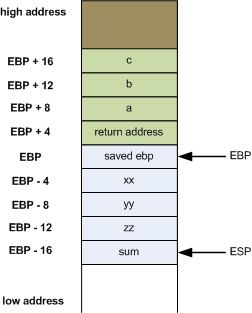
- https://eli.thegreenplace.net/2011/02/04/where-the-top-of-the-stack-is-on-x86 (x86 讚!)
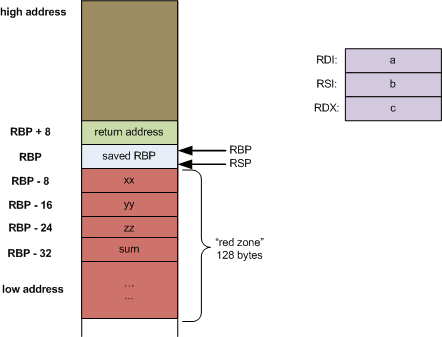
- https://eli.thegreenplace.net/2011/09/06/stack-frame-layout-on-x86-64/ (x64 讚!)
- C的function call與stack frame心得
- https://www.quora.com/What-is-the-difference-between-a-stack-pointer-and-a-frame-pointer
- https://en.wikipedia.org/wiki/Call_stack
Herein lies the source of the confusion. Intel's x86 architecture places its stack "head down". It starts at some address and grows down to a lower address. Here's how it looks:
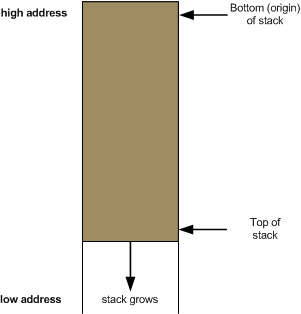
So when we say "top of the stack" on x86, we actually mean the lowest address in the memory area occupied by the stack. This may be unnatural for some people [2]. As long as we keep the diagram shown above firmly in mind, however, we should be OK.
int foobar(int a, int b, int c)
{
    int xx = a + 2;
    int yy = b + 3;
    int zz = c + 4;
    int sum = xx + yy + zz;

    return xx * yy * zz + sum;
}

int main()
{
    return foobar(77, 88, 99);
}
long utilfunc(long a, long b, long c)
{
    long xx = a + 2;
    long yy = b + 3;
    long zz = c + 4;
    long sum = xx + yy + zz;

    return xx * yy * zz + sum;
}