Question about maintenance of the Async and Sync client function signatures #2619


-
|
I am working on a library that has support for sync and async and I quite like the way HTTPX does it. A BaseClient class with no IO that regroups everything that can be shared between sync and async Client(BaseClient) the "sync" version of the client The method signature between the sync and async clients are then identical with the exception of they keyword async in front of the AsyncClient version of it. Those functions are not implemented at all in the BaseClient. My main question is, how do you maintain those 2 signatures? Is it just manual or is there a way to test for the difference during CI/CD to make sure that both public methods with the same name have the same parameters/response types def options(
self,
url: URLTypes,
*,
params: typing.Optional[QueryParamTypes] = None,
headers: typing.Optional[HeaderTypes] = None,
cookies: typing.Optional[CookieTypes] = None,
auth: typing.Union[AuthTypes, UseClientDefault] = USE_CLIENT_DEFAULT,
follow_redirects: typing.Union[bool, UseClientDefault] = USE_CLIENT_DEFAULT,
timeout: typing.Union[TimeoutTypes, UseClientDefault] = USE_CLIENT_DEFAULT,
extensions: typing.Optional[RequestExtensions] = None,
) -> Response:
"""
Send an `OPTIONS` request.
**Parameters**: See `httpx.request`.
"""
return self.request(
"OPTIONS",
url,
params=params,
headers=headers,
cookies=cookies,
auth=auth,
follow_redirects=follow_redirects,
timeout=timeout,
extensions=extensions,
)and async async def options(
self,
url: URLTypes,
*,
params: typing.Optional[QueryParamTypes] = None,
headers: typing.Optional[HeaderTypes] = None,
cookies: typing.Optional[CookieTypes] = None,
auth: typing.Union[AuthTypes, UseClientDefault] = USE_CLIENT_DEFAULT,
follow_redirects: typing.Union[bool, UseClientDefault] = USE_CLIENT_DEFAULT,
timeout: typing.Union[TimeoutTypes, UseClientDefault] = USE_CLIENT_DEFAULT,
extensions: typing.Optional[RequestExtensions] = None,
) -> Response:
"""
Send an `OPTIONS` request.
**Parameters**: See `httpx.request`.
"""
return await self.request(
"OPTIONS",
url,
params=params,
headers=headers,
cookies=cookies,
auth=auth,
follow_redirects=follow_redirects,
timeout=timeout,
extensions=extensions,
) |
Beta Was this translation helpful? Give feedback.
Replies: 2 comments

-
Good question. So... There's not actually too much duplicated async/sync code in That applies to the This is different to the approach that we take in the The auto-generation approach is based on ideas from the |
Beta Was this translation helpful? Give feedback.
-
|
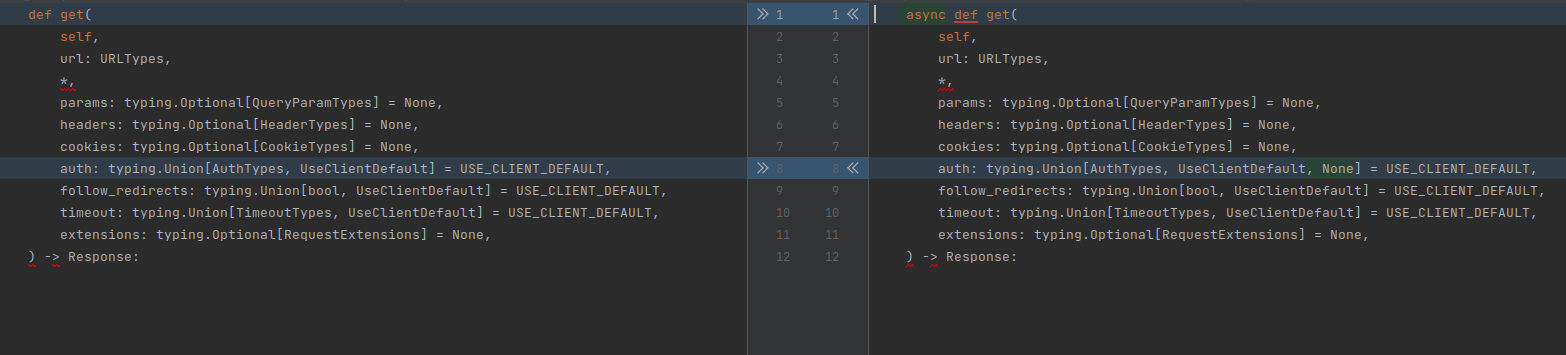
Thanks for the detailed answer, this helps a lot for my design def compare_2_classes(sync_klass: type, async_klass: type) -> dict:
"""
compare the signature of 2 class definition ignoring private methods
check that async_klass has a method with the same name of sync_klass but returning a coroutine
returns the difference between the 2 classes as a dict
"""
import inspect
sync_methods = {m for m in dir(sync_klass) if not m.startswith("_") and inspect.isfunction(getattr(sync_klass, m))}
async_methods = {
m for m in dir(async_klass) if not m.startswith("_") and inspect.iscoroutinefunction(getattr(async_klass, m))
}
common = sync_methods.intersection(async_methods)
missing_from_sync = async_methods - sync_methods
missing_from_async = sync_methods - async_methods
issues = {}
if len(missing_from_sync):
issues["missing_from_sync"] = missing_from_sync
if len(missing_from_async):
issues["missing_from_async"] = missing_from_async
# Compare each function signature types
for method in common:
sync_sig = inspect.signature(getattr(sync_klass, method))
async_sig = inspect.signature(getattr(async_klass, method))
if sync_sig != async_sig:
issues[method] = {}
issues[method]["issues"] = []
for param_sync, param_async in zip(sync_sig.parameters.items(), async_sig.parameters.items(), strict=True):
if param_sync != param_async:
key_sync, params_sync = param_sync
key_async, params_async = param_async
issues[method]["issues"].append(f"param {key_sync} | {key_async} {params_sync} != {params_async}")
issues[method]["sync_sig"] = str(sync_sig)
issues[method]["async_sig"] = str(async_sig)
return issuesOut of curiosity I tested it on httpx Client vs AsyncClient and found one issue, the |
Beta Was this translation helpful? Give feedback.


Good question. So... There's not actually too much duplicated async/sync code in
httpx. In this case we just manage that maintainance via code review. As you say, "manually".That applies to the
ClientandAsyncClientcases, and also to a few methods on theResponsemodel, such asread()vs.aread().This is different to the approach that we take in the
httpcorepackage, which is the networking layer we use inhttpx. In that case we have a script that gener…