Automated Specification and Visualization of Multi-Agent Systems





ORCA converts natural-language requirements into structured multi-agent system specifications. The system supports specification of agent roles, communication topologies, tools, constraints, and execution parameters. It is intended for design exploration, analysis, and prototyping of multi-agent architectures.
The system focuses on design-time automation: specification generation, requirement elicitation, and visualization. It does not provide execution, training, or deployment capabilities.
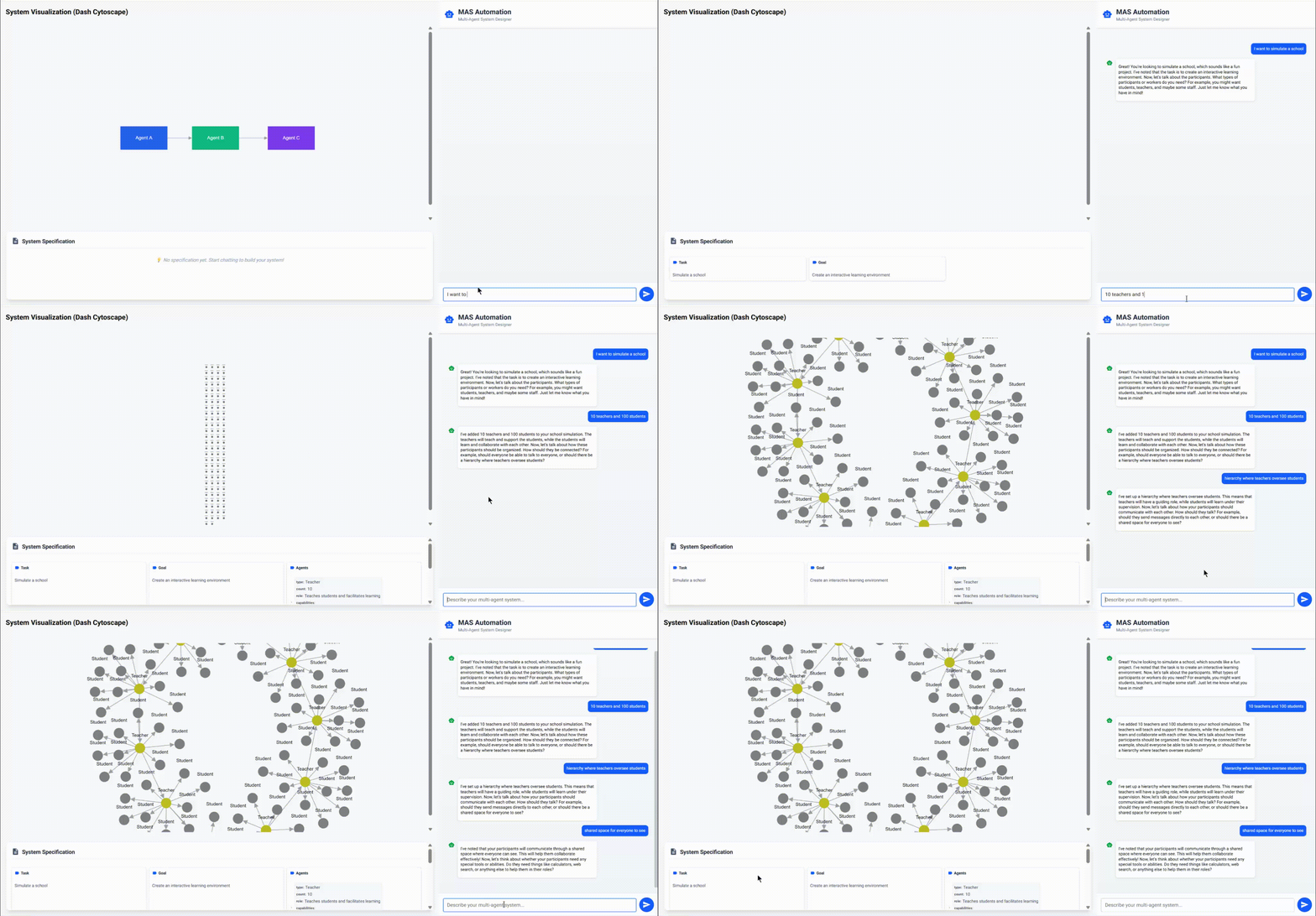
Interactive design and visualization interface (demonstration).
- Natural-language requirement elicitation - Iterative refinement of multi-agent system requirements through structured dialogue
- Real-time graph visualization - Dynamic rendering of agent relationships and communication topologies
- Structured specification generation - Automatic generation of specifications including agents, tools, topology, and constraints
- Framework-agnostic specification - Output compatible with multiple MAS frameworks (LangGraph, CrewAI, Concordia)
- Interactive refinement - Incremental specification updates through clarification and constraint discovery
- Python 3.10 or higher
- OpenAI API key
-
Clone the repository
git clone https://github.com/yourusername/orca.git cd orca -
Install dependencies
pip install -r requirements.txt
-
Configure environment
Create a
.envfile in the project root:OPENAI_API_KEY=your_openai_api_key_here
-
Run the system
python run.py
This starts both services:
- Backend API: http://localhost:8000
- Frontend UI: http://localhost:8080
Backend:
uvicorn backend.main:app --reload --port 8000Frontend:
python webui/app.py- Open http://localhost:8080
- Provide initial requirements for the multi-agent system:
- "Build a customer service system with a manager and three specialist agents"
- "Create a simulation of a school with 200 students and 10 teachers"
- "Design an anomaly detection system with monitoring and analysis agents"
- The system performs requirements elicitation:
- Identifies missing or ambiguous requirements
- Requests clarification through structured questions
- Updates the MAS specification incrementally
- Renders the agent architecture visualization
- Generates a specification summary
The system consists of a backend specification engine and a frontend interaction interface. The backend processes natural-language input, maintains the current specification state, and generates graph visualizations. The frontend provides the interaction interface and displays the specification and visualization.
orca/
├── backend/
│   ├── main.py                      # FastAPI application entry point
│   ├── engine/
│   │   ├── mas_engine.py            # Core MAS automation engine
│   │   └── requirements_agent/
│   │       ├── agent.py             # LLM-powered requirements extractor
│   │       └── prompts/             # Prompt templates
│   └── models/                      # Data models and schemas
├── webui/
│   └── app.py                       # NiceGUI frontend application
├── run.py                           # Combined launcher script
├── requirements.txt                 # Python dependencies
├── .env                             # Environment configuration
└── README.md                        # This file
| Component | Technology | Purpose |
|---|---|---|
| Backend | FastAPI | REST API for chat handling and MAS engine execution |
| Frontend | NiceGUI | Interactive conversational interface and visualization |
| Visualization | Cytoscape.js | Dynamic graph rendering of agent architectures |
| Language Model | OpenAI GPT-4 | Natural language understanding and specification generation |
| Runtime | Python 3.10+ | Core application runtime |
Processes user messages and returns updated system state.
Request Body:
{
  "message": "string",
  "history": [
    {"role": "user", "content": "string"},
    {"role": "assistant", "content": "string"}
  ]
}
Response:
{
  "reply": "Assistant response message",
  "graph": [
    {"data": {"id": "agent1", "label": "Manager"}},
    {"data": {"source": "agent1", "target": "agent2"}}
  ],
  "spec": {
    "task": "string",
    "goal": "string",
    "agents": ["string"],
    "tools": ["string"],
    "communication": "string",
    "topology": "string",
    "constraints": {}
  },
  "spec_text": "Natural language design summary"
}- Conversational MAS design interface
- Real-time architecture visualization
- Multi-framework specification generation
- Code generation - Export runnable Python projects
- Template library - Pre-built MAS patterns
- Simulation runner - Execute and test generated systems
- Multi-LLM support - Support for Claude, Gemini, and open-source models
- Collaborative design - Multi-user system design sessions
Contributions are welcome. Please submit a Pull Request.
- Fork the repository
- Create your feature branch (
git checkout -b feature/AmazingFeature) - Commit your changes (
git commit -m 'Add some AmazingFeature') - Push to the branch (
git push origin feature/AmazingFeature) - Open a Pull Request
This project is licensed under the MIT License - see the LICENSE file for details.
- Built with FastAPI
- UI powered by NiceGUI
- Visualization by Cytoscape.js
- Language model capabilities by OpenAI
Project Link: https://github.com/yourusername/orca