
From a single text prompt to an interactive VR scene.
Text2VR is a research-driven system that turns natural language descriptions into VR-ready 3D environments and assets, combining panorama generation, asset extraction, 3D reconstruction, and VR deployment in a single pipeline.
The organization currently maintains a single main repository:
- Repository:
Text2VR/Text2VR
– LangGraph-based backend pipeline (app/, microservice clients, workflows)
– React + TypeScript frontend (src/)
– Service directories for panorama, segmentation, inpainting, and 3D generation
– Docker Compose configuration and pretrained checkpoint folders
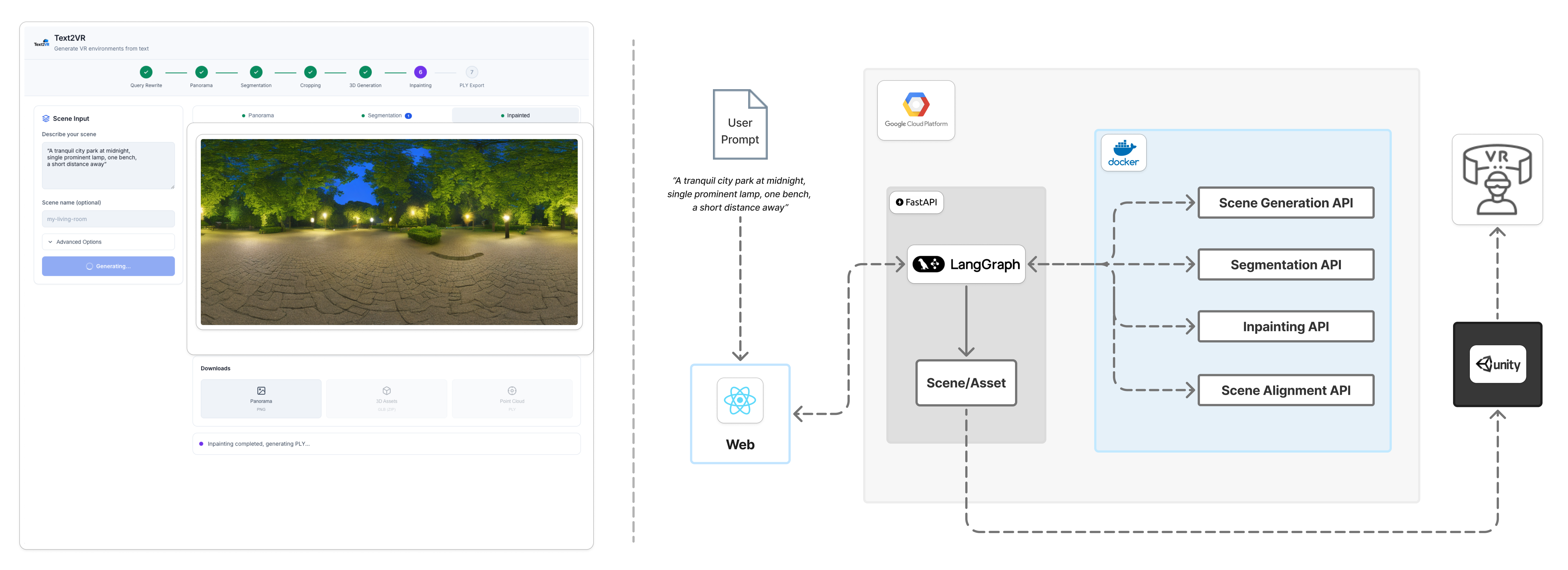
High-level system architecture (see the main repo for full details):
Text2VR is developed in the context of HCI and game/VR research:
- Submitted to Journal of Korea Computer Game Society (JKCGS)
- Text2VR: A Modular Pipeline for Interactive VR Scenes from a Single Text Prompt
CM. Lee*, S. Myoung*, M. An*, Y. Jin*, EC. Lee†.
Note: (*: Co-first Author, †: Corresponding Author)
- Extended journal version emphasizing VR content authoring workflows, automatic asset/background generation, and interactive VR scene construction using Text2VR.
The code in this organization corresponds to these works and is intended to be reproducible and extensible for further research.
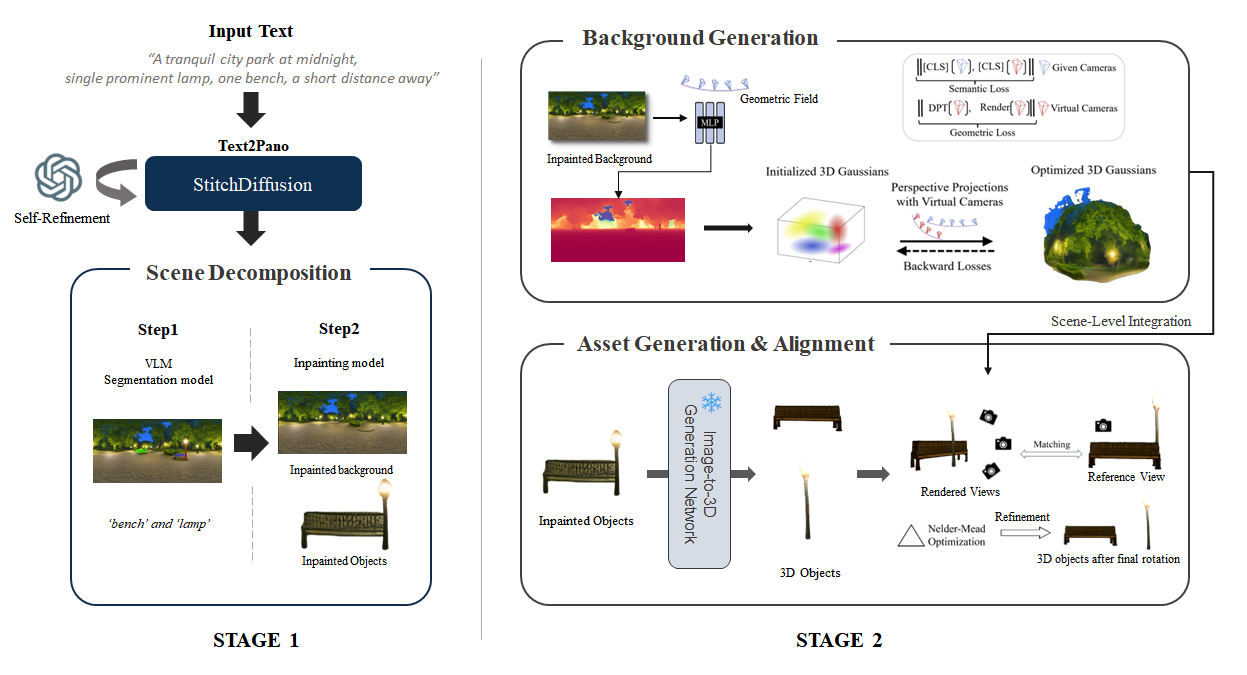
At a high level, the Text2VR pipeline:
- Rewrites user prompts into optimized generation queries (LLM-based query rewrite via LangGraph).
- Generates a 360° panorama from the prompt using DreamScene360 (Stable Diffusion + Stitch Diffusion), with optional self-refinement.
- Segments interactive objects using GPT-4o + GroundingDINO + SAM and crops them as RGBA assets.
- Converts 2D crops into 3D assets with TRELLIS, producing GLB models.
- Inpaints the background after object removal using Stable Diffusion 2 Inpaint (wrap-aware).
- Trains a 3D Gaussian Splatting background from the inpainted panorama (PLY) for immersive VR rendering.
- Packages everything for VR, so scenes can be explored in a VR engine (e.g., Unity with a Gaussian Splatting plugin and colliders/interaction scripts).
A more detailed pipeline overview is available in the Text2VR repository:
-
LangGraph Orchestration
Explicit workflow graph managing query rewrite, panorama generation, segmentation, inpainting, 3D asset generation, and Gaussian Splatting. -
Microservice Architecture (via Docker Compose)
Separate containers for:- Panorama generation (
DREAMSCENE360/→panorama-api) - Segmentation (
ASSET_SEG/→segmentation-api) - Inpainting (
BG_INPAINT/→inpainting-api) - 3D asset generation (TRELLIS →
trellis-api)
- Panorama generation (
-
Frontend Integration
React + TypeScript frontend (src/) for:- Prompt input and scene naming
- Real-time pipeline status and intermediate previews
- Result browsing and download (panorama, assets, PLY, Unity export)
-
VR-focused Outputs
- 3D Gaussian Splatting background (PLY)
- GLB assets ready for import into VR engines
- Unity-ready export endpoints (
unity_assetsAPI) for building interactive VR scenes
For full details, see the Text2VR repository README. At a glance:
app/– FastAPI backend and LangGraph workflowsrc/– React frontendDREAMSCENE360/– Panorama generation serviceASSET_SEG/– Segmentation serviceBG_INPAINT/– Background inpainting servicedocker-compose.yml– Microservice orchestrationdocs/– Architecture and pipeline diagramspre_checkpoints/– Pretrained model weights
Text2VR is developed by Team GARASANI (Capstone Design · Graduation 2025).
 Chang-Min Lee @LeeChangmin0310 Project Lead & Maintainer |
 Soo-Youn Myoung @suyeonmyeong Core Contributor |
 Moon-Sik An @dalsik Core Contributor |
 Young-In Jin @0in11 Core Contributor |
“Garasani (가라사니): the spark of perception, the thread of insight.”
Text2VR explores how unstructured prompts can be transformed into structured, interactive 3D worlds.
- The HCI conference paper and the computer game journal version both reference this organization as the implementation source.
- To reproduce the system:
- Start from
Text2VR/Text2VR - Follow the repository README for environment setup, model downloads, and pipeline execution
- Start from
- Issues and feature requests can be opened on the main repository.