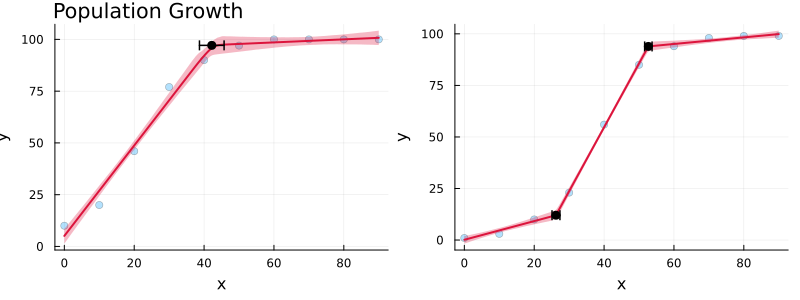
A package for quickly estimating when changes in data behavior occur between two variables using Bayesian inference. Envisioned for biologists interested in asking: what is the probability that population A and B reached plateau growth phase at the same time, accounting for growth rates?
Fastbreak.jl is best specified for a small number of breakpoints, i.e. a small number of time-dependent interventions or hypothesized changes in behvaior.
Identifying the probable interval of time that population growth curves change behavior (exponential/linear/plateau) can be calculated almost instantly using either point estimate (MAP) or full posterior estimation using MCMC. Hypothesis testing on breakpoints can be performed intuitively using either the full posterior (best) or Wald test.
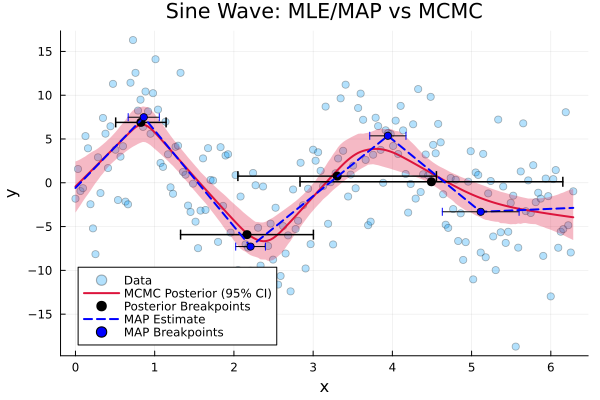
Segmented regression can be used to fit more complicated functions. Fastbreak.jl uses the same ordered vector approach as Stan for breakpoints, however this imposes a funneling effect that makes MCMC difficult with many dense breakpoints. Shown below is a segmented regression fit to a noisy sine curve. In this case, the posterior estimated via MCMC appears to better estimate
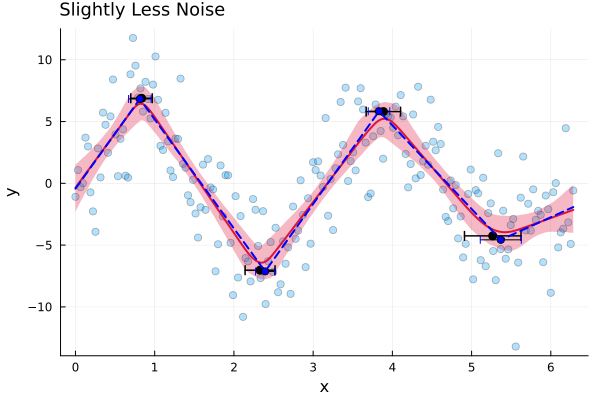
Indeed, despite being well outside the scope of most change point analyses, good fits can be achieved for larger numbers of breakpoints. However, numerical and sampling stability becomes a challenge. Keep in mind that despite modeling
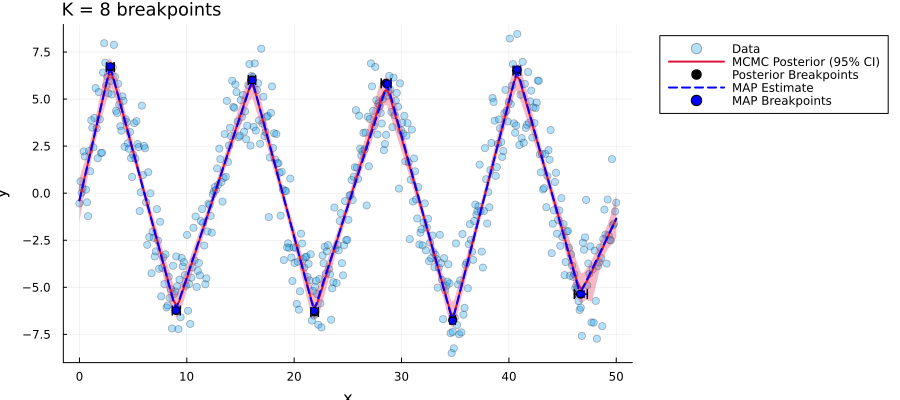
FastBreak fits piecewise linear regression models with an arbitrary number of breakpoints using a fast MCMC sampler (< 1s for 2000 samples on hundreds of observations). All parameters are estimated jointly rather than in an iterative fashion. The package uses a hardcoded logposterior gradient to yield either a MAP estimate or full posterior samples via MCMC in a flash.
FastBreak differs from R's segmented library in its joint estimation of parameter values using standard optimization techniques.
Full Bayesian posterior for inference on generated and derived statistics.
- Multiple breakpoints: Fit models with any number of breakpoints
- Fast optimization: Analytical gradients and Hessians for Newton's method
- Statistical inference: Standard errors, confidence intervals, and correlation matrices on breakpoints and slopes.
- Simple API: Intuitive interface for model specification and fitting
using Pkg
Pkg.add("FastBreak")FastBreak fits piecewise linear models of the form:
y = β₁ + β₂x + Σᵢ βᵢ₊₂ max(0, x - ψᵢ) + ε
where:
β₁is the interceptβ₂is the initial slopeβᵢ₊₂are slope changes at each breakpointψᵢare the breakpoint locationsε ~ N(0, σ²)is Gaussian noise
using FastBreak

# Generate synthetic data
x = collect(0.0:100.0)
true_breakpoints = [31, 69]
true_β = [10.0, 0.5, -1.0, 0.8]
true_σ = 3.0

# Create model
model = SegmentedModel(x, y, n_breakpoints=2)

# Fit model
results = fit!(model, show_trace=false)

# Print results
print_results(results)

======================================================================
MAXIMUM LIKELIHOOD ESTIMATION RESULTS
======================================================================
Converged: true
Iterations: 28
Negative Log-likelihood: 155.70509373999525

SLOPE/INTERCEPT PARAMETERS (β):
----------------------------------------------------------------------
Intercept      :    11.3248  (SE:   0.9509)  [    9.4610,    13.1887]
Slope 1        :     0.4184  (SE:   0.0495)  [    0.3213,     0.5155]
Slope 2        :    -1.0367  (SE:   0.0701)  [   -1.1740,    -0.8994]
Slope 3        :     0.9388  (SE:   0.0717)  [    0.7983,     1.0793]

BREAKPOINT LOCATIONS (ψ):
----------------------------------------------------------------------
ψ[1]           :      33.09  (SE:   1.3267)  [     30.49,      35.69]
  (rounded)    : 33
ψ[2]           :      67.53  (SE:   1.4757)  [     64.64,      70.42]
  (rounded)    : 68

NOISE PARAMETER (σ):
----------------------------------------------------------------------
σ              :     2.8338  (SE:   0.1994)  [    2.4430,     3.2246]

CORRELATION MATRIX (selected parameters):
----------------------------------------------------------------------
  1.000  -0.860   0.608   0.000   0.333
 -0.860   1.000  -0.707  -0.000  -0.598
  0.608  -0.707   1.000  -0.489  -0.021
  0.000  -0.000  -0.489   1.000   0.433
  0.333  -0.598  -0.021   0.433   1.000

======================================================================
Confidence Level: 95.0%
======================================================================

# Make predictions
y_pred = results(x)model = SegmentedModel(
x, y,
n_breakpoints;
ψ_prior_range=(min_x, max_x) # Bounds for breakpoint locations
)results = fit!(
model;
max_iter=1000, # Maximum optimization iterations
show_trace=false, # Show optimization progress
confidence_level=0.95 # Confidence level for intervals
)# Parameter estimates
results.θ.β # Slope coefficients
results.θ.ψ # Breakpoint locations
results.θ.σ # Noise standard deviation
# Statistical inference
results.β_se # Standard errors for β
results.β_ci # Confidence intervals for β
results.ψ_se # Standard errors for ψ
results.ψ_ci # Confidence intervals for ψ
# Covariance structure
results.covariance_matrix
results.correlation_matrix
results.hessian- Optim.jl: Optimization algorithms
- LinearAlgebra: Matrix operations
- StatsBase: Statistical utilities
See LICENSE file for details.
Dan Sprague (dsprague@broadinstitute.org)