




This package contains a complete environment for controlling and visualizing DotBots.
The DotBots hardware design can be found here (PCB). The firmware running on the DotBots can be found here.
This package can also be used to control devices running the SailBot firmware application.
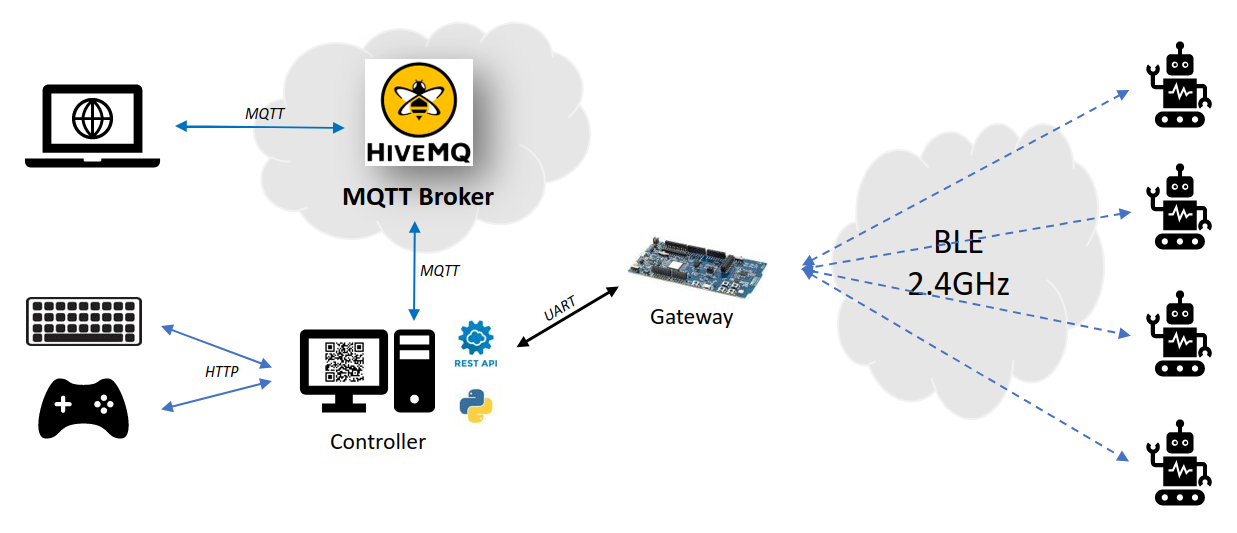
Run pip install pydotbot
Flash the required firmwares on the DotBots and gateway board (use an nRF52833DK/nRF52840DK/nrf5340DK board as gateway), as explained in the DotBots firmware repository.
dotbot-controller --help
Usage: dotbot-controller [OPTIONS]

  DotBotController, universal SailBot and DotBot controller.

Options:
  -a, --adapter [serial|edge|cloud]
                                  Controller interface adapter. Defaults to
                                  serial
  -p, --port TEXT                 Serial port used by 'serial' and 'edge'
                                  adapters. Defaults to '/dev/ttyACM0'
  -b, --baudrate INTEGER          Serial baudrate used by 'serial' and 'edge'
                                  adapters. Defaults to 1000000
  -H, --mqtt-host TEXT            MQTT host used by cloud adapter. Default:
                                  localhost.
  -P, --mqtt-port INTEGER         MQTT port used by cloud adapter. Default:
                                  1883.
  -T, --mqtt-use_tls              Use TLS with MQTT (for cloud adapter).
  -d, --dotbot-address TEXT       Address in hex of the DotBot to control.
                                  Defaults to FFFFFFFFFFFFFFFF
  -g, --gw-address TEXT           Gateway address in hex. Defaults to
                                  0000000000000000
  -s, --network-id TEXT           Network ID in hex. Defaults to 0000
  -c, --controller-http-port INTEGER
                                  Controller HTTP port of the REST API.
                                  Defaults to '8000'
  -w, --webbrowser                Open a web browser automatically
  -v, --verbose                   Run in verbose mode (all payloads received
                                  are printed in terminal)
  --log-level [debug|info|warning|error]
                                  Logging level. Defaults to info
  --log-output PATH               Filename where logs are redirected
  --help                          Show this message and exit.
By default, the controller expects the serial port to be /dev/ttyACM0, as on
Linux, use the --port option to specify another one if it's different. For
example, on Windows, you'll need to check which COM port is connected to the
gateway and add --port COM3 if it's COM3.
Using the --webbrowser option, a tab will automatically open at
http://localhost:8000/PyDotBot. The page maintains
a list of available DotBots, allows to set which one is active and controllable
and provide a virtual joystick to control it or change the color of the on-board
RGB LED.
The DotBots firmware comes with a cheap indoor positioning system based on Valve Lighthouse 2.
To get the positioning to work and the DotBots to be tracked in real-time the system must be first calibrated by clicking the "Start calibration" or "Update calibration" button below the grid map and then by following the instructions there.
To run the tests, install tox and use it:
tox