A military-grade, quantum-resistant cold storage solution designed as a secure alternative to traditional cryptocurrency cold wallets. QuantumVault provides a robust cross-platform security model for protecting your digital assets against both current and future threats.
Encrypted cold storage system with AES-256 + custom DOS bootloader for DOS-based decryption capabilities.
Website: https://harrisonsec.com/projects/quantumvault/
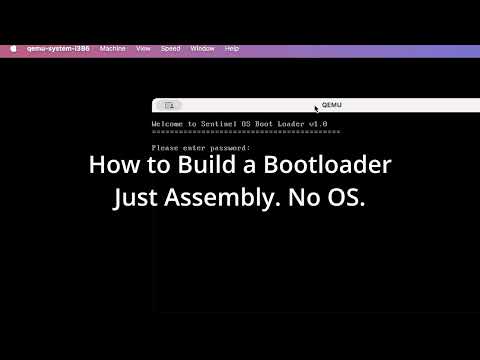
This video demonstrates the custom x86 bootloader included in SentinelDOS/.
It shows BIOS-based execution from 0x7C00, MBR parsing, CHS extraction, shared memory writing, and INT 13h loading of Stage 2 with password protection.

🚀 From Real Mode to Protected Mode — Full GDT/IDT Control with Exception, IRQ, and Integrity Verification

This demo takes the CPU from 16-bit real mode into 32-bit protected mode, then sets up a complete, verifiable interrupt environment before any OS loads:
- ✅ Custom GDT & IDT — two entry methods: runtime GDT patch & flat addressing
- ✅ Exception handling for vectors 0–19 (with and without error codes)
- ✅ Hardware interrupts: PIC remapping + IRQ0 (timer) handler with on-screen tick counter
- ✅ Integrity verification — SGDT/SIDT + 16-bit checksum to detect GDT/IDT tampering in real time
- ✅ Custom INT 0x30 handler with VGA debug output
- Overview
- Key Advantages
- System Architecture
- Quantum Resistance
- Security Model
- SentinelDOS Bootloader Security
- Getting Started
- Future Development
- Project Structure
- Contact
QuantumVault is a comprehensive security solution for cryptocurrency cold storage that leverages a dual-system approach:
- Encryption on Linux: Secure environment for initial encryption of wallet data
- Decryption on DOS: Air-gapped, network-isolated environment for accessing sensitive data
This separation provides defense-in-depth security while maintaining usability for cryptocurrency holders concerned about both conventional and quantum computing threats.
- Cross-Platform Security Model: Encryption on Linux with automatic cleanup, decryption on network-isolated DOS
- Military-Grade Encryption: AES-256-CBC encryption remains secure even against quantum computing attacks
- Self-Monitoring Environment: Real-time security monitoring prevents tampering and unauthorized access
- Hardware Independence: No specialized hardware required, works on standard x86 computers
- Quantum-Resistant Design: Prepared for the post-quantum cryptography era
- Extensible Architecture: Ready for hardware authentication and distributed key storage upgrades
QuantumVault employs a two-part system architecture:
- Secure key generation using PBKDF2-HMAC-SHA256 with 10,000 iterations
- AES-256-CBC encryption of wallet data
- Automated secure cleanup of plaintext files and memory
- Structured file format with salt and IV for maximum security
- Network-isolated environment for maximum security
- Self-contained implementation with minimal dependencies
- Real-time anti-tampering monitoring
- Multi-pass secure memory wiping
- Options for direct display or file output
While many cryptocurrency systems rely on elliptic curve cryptography (ECC) that may be vulnerable to quantum computing attacks, QuantumVault's use of AES-256 provides robust protection:
- Post-Quantum Security: AES-256 is considered quantum-resistant with sufficient key size
- No Known Quantum Attacks: Grover's algorithm, the best known quantum attack against symmetric ciphers, only reduces AES-256 security to approximately 128 bits - still well beyond practical attack capabilities
- Future-Proof Design: Even if Bitcoin's elliptic curve signatures become vulnerable to quantum computers, your private keys remain secure inside QuantumVault
QuantumVault implements multiple security layers:
- Cryptographic Security: AES-256-CBC with PBKDF2 key derivation
- Air-Gap Security: DOS-based decryption operates on offline systems
- Anti-Tampering Protection:
- Real-time interrupt vector table monitoring
- Keyboard hook detection
- Timer hook detection
- Runtime memory integrity verification
- Memory Protection: Multi-pass secure wiping of sensitive data
- Physical Security: System auto-reboot after decryption to clear memory
The SentinelDOS folder contains assembly code that implements a secure bootloader with password verification:
- stage1.asm: First-stage bootloader that fits in the boot sector (512 bytes)
- stage2.asm: Second-stage bootloader with password verification functionality
- Boot-Time Password Protection: Requires correct password entry before allowing access to DOS
- Three-Attempt Lockout: System automatically locks after three incorrect password attempts
- System Security Verification: Performs basic integrity checks at boot time
- btcrypt.asm: Basic cryptocurrency-related assembly routines
- attack.s, guard.s, keysave.s: Early security verification implementations in assembly
These assembly components served as a foundation for security concepts now implemented in the Decryption component using C with inline assembly in a 32-bit environment, which provides enhanced security capabilities.
Note: The assembly code in the SentinelDOS directory is provided for reference purposes. The production QuantumVault implementation uses the 32-bit protected mode environment for improved security.
- For encryption: Any modern Linux system with GCC and OpenSSL
- For decryption: DOS environment with DJGPP (can run on physical machines or emulators)
- Storage media for transferring encrypted files between systems
cd Encryption
gcc -o generate_key generate_key.c -lssl -lcrypto
gcc -o encrypt_file encrypt_file.c -lssl -lcrypto

# Generate key from password
./generate_key "your_secure_password"

# Encrypt wallet file
./encrypt_file wallet.dat encrypted_wallet.bincd Decryption
make
# Decrypt using the same password
combined_decrypt.exe -p your_secure_password encrypted_wallet.bin wallet.dat
# Or decrypt using a key file
combined_decrypt.exe -k keyfile.bin encrypted_wallet.bin wallet.dat
For detailed instructions, see the README files in the respective component folders.
The QuantumVault project roadmap includes several advanced security features:
- Hardware Fingerprinting: Binding decryption to specific hardware profiles
- Physical Authentication: Integration with physical security keys and biometric verification
- Distributed Key Storage:
- Shamir's Secret Sharing for key splitting across multiple locations
- Individual encryption of each key fragment
- Redundancy allowing recovery even if some fragments are lost
- Inclusion of decoy fragments to resist forced disclosure attacks
- Multi-Cryptocurrency Support: Expanded support for various cryptocurrency wallet formats
- Hardware Security Module Integration: Optional integration with HSMs for enterprise use cases
QuantumVault/
├── Encryption/           # Linux-based encryption tools
│   ├── encrypt_file.c    # File encryption utility
│   ├── generate_key.c    # Key generation utility
│   └── README.md         # Encryption component documentation
├── Decryption/           # DOS-based decryption tools
│   ├── combined_decrypt.c    # Main decryption program with security features
│   ├── security_check.c      # Anti-tampering module with inline assembly
│   ├── aes.c                 # AES implementation
│   └── README.md             # Decryption component documentation
├── SentinelDOS/          # Reference bootloader security code
│   ├── stage1.asm        # First-stage bootloader
│   ├── stage2.asm        # Second-stage bootloader with full password verification
│   ├── btcrypt.asm       # Basic assembly routines
│   ├── attack.s          # Security verification code
│   ├── guard.s           # Security protection routines
│   └── keysave.s         # Key storage functionality
└── README.md             # This file
Encrypted cold storage system with AES-256 + custom DOS bootloader for pre-OS password-based decryption.
Website: https://harrisonsec.com/projects/quantumvault/
For consultations, custom implementations, or questions about QuantumVault for high-security cryptocurrency storage:
Email: consult@harrisonsec.com
QuantumVault is provided as-is without warranty. Users are responsible for their own security practices and key management.