Observing External Data
Return to The role of Time
In Netrium, almost all numbers and decisions that are exposed through the language can be accessed as Observables. Observables are time-dependent observations of either numeric or boolean data types.
contract = scale cpardFoo (one (Financial eur cash Nothing)) In the above example, cpardFoo is registered in the Observable database as a double. When simulating the contract, a value will need to be supplied - along with a validity date - so that the contract can be successfully executed.
The Syntax Tree shows this as follows:

Through the Netrium Contract Engineer (a part of the commercial toolset), the observable can be edited as follows:
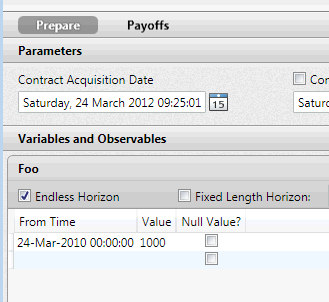
Which is simply a user interface on top of the observable XML file:
   <?xml version="1.0"?>
   <SimulationInputs>
       <Time>2012-03-24 09:25:01 UTC</Time> <!-- start time -->
       <ObservationSeries var="cpardFoo" type="Double">
           <SeriesEntry>
             <Time>2010-03-24 00:00:00 UTC</Time>
             <Double>1000</Double>
           </SeriesEntry>
           <SeriesUnbounded/>
       </ObservationSeries>
       <Choices/>
   </SimulationInputs>
After execution, the results returned show the Observable in action:
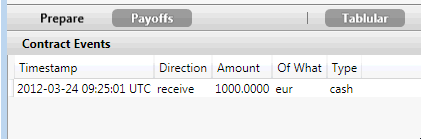
There are many times in which the contract may need to observe a double, and convert that into a boolean condition. This is done very simply in Netrium, using standard relational operators. Below is a sample barrier option, in which the option can only be exercised if the observed temperature drops below 5 degrees.


How to add new elements to the language