


merra2ools is an R package and dataset for evaluating the potential output of variable energy resources (VER) — specifically wind and solar — globally, using over 40 years of hourly MERRA-2 reanalysis data. The dataset was assembled, and the package initially developed, to support the authors’ internal and collaborative energy modeling studies, and is made available for public use. Further development will be guided by the needs of related research projects and contributions from the broader community. See {dev-status} for details.
The primary goal of merra2ools is to provide energy modelers and analysts with:
- A curated, long-term subset of MERRA-2 data relevant to energy modeling.
- A toolkit for estimating hourly potential output and capacity factors of wind and solar energy.
- Basic support for hydro power output potential using precipitation and surface runoff indicators.
- Access to a global, multi-decade MERRA-2 dataset compressed for efficient use.
- Scaled and rounded time series data stored as compressed integers to reduce storage while preserving relevant signal.
- Functions to estimate capacity factors and potential output across regions and time.
The merra2ools dataset includes a 41-year (1980–2020) hourly time
series of selected indicators from the NASA MERRA-2 reanalysis dataset.
The data is preprocessed, scaled, and compressed to reduce file size
while preserving sufficient accuracy for renewable energy modeling. The
data is downloadable from
Dryad cloud repository. A
sample data can be installed from the merra2sample package.
Each record is indexed by:
UTC— Hourly timestamp in Coordinated Universal Time (UTC)locid— Location ID (integer from 1 to 207,936, corresponding to MERRA-2 grid cells)
| Variable | Description |
|---|---|
W10M |
Wind speed at 10 m, computed as sqrt(U10M² + V10M²), rounded to 0.1 m/s |
W50M |
Wind speed at 50 m, computed similarly, rounded to 0.1 m/s |
WDIR |
Wind direction at 50 m, atan2(V50M, U50M), rounded to nearest 10° |
T10M |
Air temperature at 10 m (°C), rounded to nearest integer |
SWGDN |
Surface shortwave radiation (W/m²), rounded to nearest integer |
ALBEDO |
Surface albedo [0–1], rounded to 0.01 |
PRECTOTCORR |
Total precipitation (kg/m²/h), bias-corrected, rounded to 0.1 |
RHOA |
Surface air density (kg/m³), rounded to 0.01 |
- All values are stored as scaled integers to reduce size while maintaining numerical usability.
- Files are compressed using a high-efficiency format (e.g.,
fstwith potential conversion toparquet, or custom binary) to keep the total dataset under 300 GB. - Partial data loading is supported, allowing users to work with only the necessary time periods or variables.
# install.packages("pak") # if not installed
pak::pkg_install("optimal2050/merra2ools") # install the package
pak::pkg_install("optimal2050/merra2sample") # optional - example dataset
Download datasets from https://doi.org/10.5061/dryad.v41ns1rtt to a local folder. It is not required to download all the data, but it is suggested to download at least for one full year (12 months).
library(merra2ools)
# link the package with the downloaded data
set_merra2_options(merra2.dir = "PATH TO THE DOWNLOADED DATA")
get_merra2_dir()  # check if the path is saved
check_merra2(detailed = T)
See Get
started
article (or call vignette("merra2ools", package = "merra2ools")) for
details.
The package reproduces basic algorithms of solar geometry, irradiance
decomposition, and the Plane-Of-Array models for different types of
solar PV trackers.
See Solar
Power
article (or callvignette("solarpower", package = "merra2ools")) for
details.

The package includes basic algorithms for estimating wind power
potential and capacity factors. It uses the MERRA-2 wind speed at 10 and
50 meters above ground level (AGL) to extrapolate wind speed at higher
altitudes and estimates the wind power potential based on given wind
power curves.
See Wind
Power
article (or call vignette("windpower", package = "merra2ools")) for
details.

See the MERRA-2
subset
article (or call vignette("merra2", package = "merra2ools")) for a
complete list of included time series and a detailed description of the
dataset.
Youtube channel merra2ools
features visualization of 40 years of hourly (60 h/s) wind speed using
the merra2ools package.
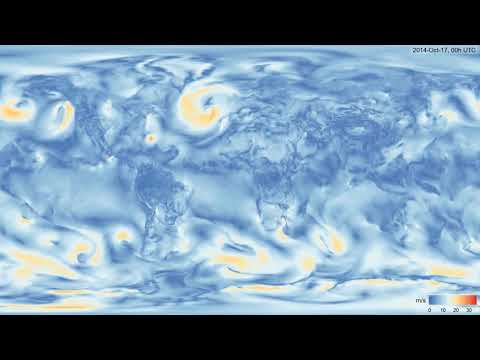
Click the image to watch the wind speed visualization demo on YouTube.
We welcome contributions to the merra2ools package! Please see our Contributing Guidelines for details on how to get involved. Or simply open an issue, pull request, or feature request on GitHub.
This package is licensed under the GNU Affero General Public License v3.0. The data is available under the CC0 1.0 Universal (CC0 1.0) Public Domain Dedication.
-
Lugovoy, O., & Gao, S. (2023). merra2ools: Satellite data and tools for retrospective assessment of renewable energy production (R package version 0.1.05). Available at: https://optimal2050.github.io/merra2ools/
-
The solar PV performance estimation module in
merra2oolsreproduces core elements of the modeling approach described by the Solar PV Performance Modeling Collaborative (PVPMC).
-
Gelaro, R., et al. (2017). The Modern-Era Retrospective Analysis for Research and Applications, Version 2 (MERRA-2). Journal of Climate, 30(14), 5419–5454. https://doi.org/10.1175/JCLI-D-16-0758.1
-
Bosilovich, M. G., Lucchesi, R., & Suarez, M. (2016). MERRA-2: File Specification. GMAO Office Note No. 9 (Version 1.1), 73 pp. Available at: http://gmao.gsfc.nasa.gov/pubs/office_notes
-
NASA Global Modeling and Assimilation Office (GMAO). MERRA-2: The Modern-Era Retrospective analysis for Research and Applications, Version 2. Available at: https://gmao.gsfc.nasa.gov/reanalysis/merra-2/
-
Global Modeling and Assimilation Office (GMAO) (2015), MERRA-2 tavg1_2d_rad_Nx: 2d, 1-Hourly, Time-Averaged, Single-Level, Assimilation, Radiation Diagnostics, 0.625 x 0.5 degree, V5.12.4 (M2T1NXRAD) at GES DISC. Accessed: 2019–2020. DOI: 10.5067/Q9QMY5PBNV1T
-
Global Modeling and Assimilation Office (GMAO) (2015), MERRA-2 tavg1_2d_slv_Nx: 2d, 1-Hourly, Time-Averaged, Single-Level, Assimilation, Single-Level Diagnostics, V5.12.4 (M2T1NXSLV) at GES DISC. Accessed: 2019–2020. DOI: 10.5067/VJAFPLI1CSIV